For almost three years, I’ve been living aboard SY MarySol together with my husband Niels and our dogs Yuki and Carlito. We set sail from Northern Europe and have since crossed the Atlantic via Africa and Brazil to the Caribbean.
One thing that has become central to our life on board: avoiding waste — especially plastic.
Before we left, I ran two zero-waste shops in Hamburg. Now, I’ve had the chance to explore what low-waste living looks like while sailing.
80 tons of waste — every day
We are moored beneath the iconic Sugarloaf Mountain in Rio de Janeiro. A gust turns the boat slightly, and suddenly Christ the Redeemer looks down at us from above Guanabara Bay.
It’s surreal to realize we sailed here on our own keel.
Rio immediately captivates us — its lightness, its energy. From our anchorage, it’s just a short dinghy ride to the beach. Canoes are pulled ashore, vendors walk between umbrellas, children play in the sand.
And yet — like almost everywhere in the world — there’s another reality.
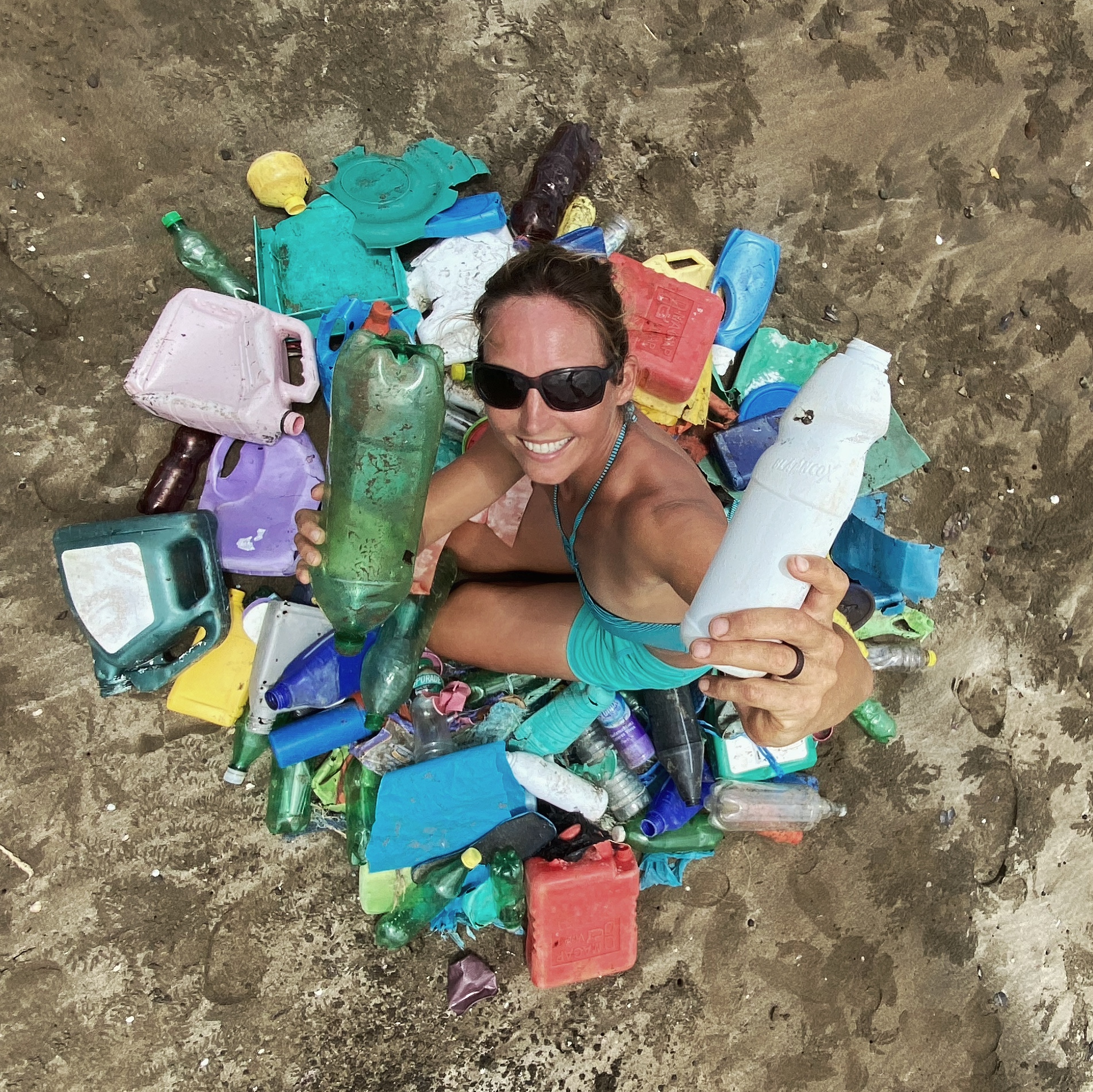
In the water, alongside swimmers and turtles, we see plastic. A lot of it.
Around 80 tons of waste enter this bay every day, mostly via rivers. A number like that puts things into perspective. It reminds us why reducing waste on board matters — even if our individual impact feels small.
Because: the best waste is the waste that never exists.
Where does waste actually come from on board?
Reducing waste starts with something simple: taking a closer look.
What do you actually throw away?
Food packaging? Plastic bottles? Drink cartons? Paper towels?
Often, just becoming aware of your own patterns already shows you where change is possible.
Maybe you’ve taken part in the Trash Navigator Challenge that In Mocean launched on Zero Waste Day. It’s a great starting point to really see what accumulates. If you haven’t yet, it’s not too late to join — you can sign up and get your Trash Diary.
Even for us, already paying attention to many of these things, tracking our waste for seven days was surprisingly revealing. There were still small habits we hadn’t really questioned — and small things we could shift.
Avoiding packaging while provisioning
Our first step is always the same: look for ways to buy things unpackaged.
If that’s not possible, we choose alternatives — glass instead of plastic, paper instead of composite packaging, refillable options whenever available.
While paper, glass, and metal also have downsides, they don’t break down into microplastics — and that makes a big difference.
Water: the hidden plastic trap
One of the biggest waste sources is drinking water.
In many regions, tap water isn’t drinkable — which means buying bottled water. And that adds up quickly.
We installed a watermaker before heading south. Without it, we would have gone through around 220 large plastic bottles in just one year — just for the two of us.
Finding low-waste options around the world
Before arriving somewhere new, we do a quick search.
Depending on the country, useful keywords are:
zero waste shop, bulk store, farmers market, organic, eco, health food — or local equivalents like vrac, granel or orgánico.
And the beautiful thing is: you’ll find options almost everywhere.
From Scotland to Spain, Portugal to Brazil — we kept discovering places to shop without packaging. Sometimes planned. Sometimes by pure chance.
And often, these places lead to conversations, connections, and unexpected encounters.
How it works on board
The system is simple:
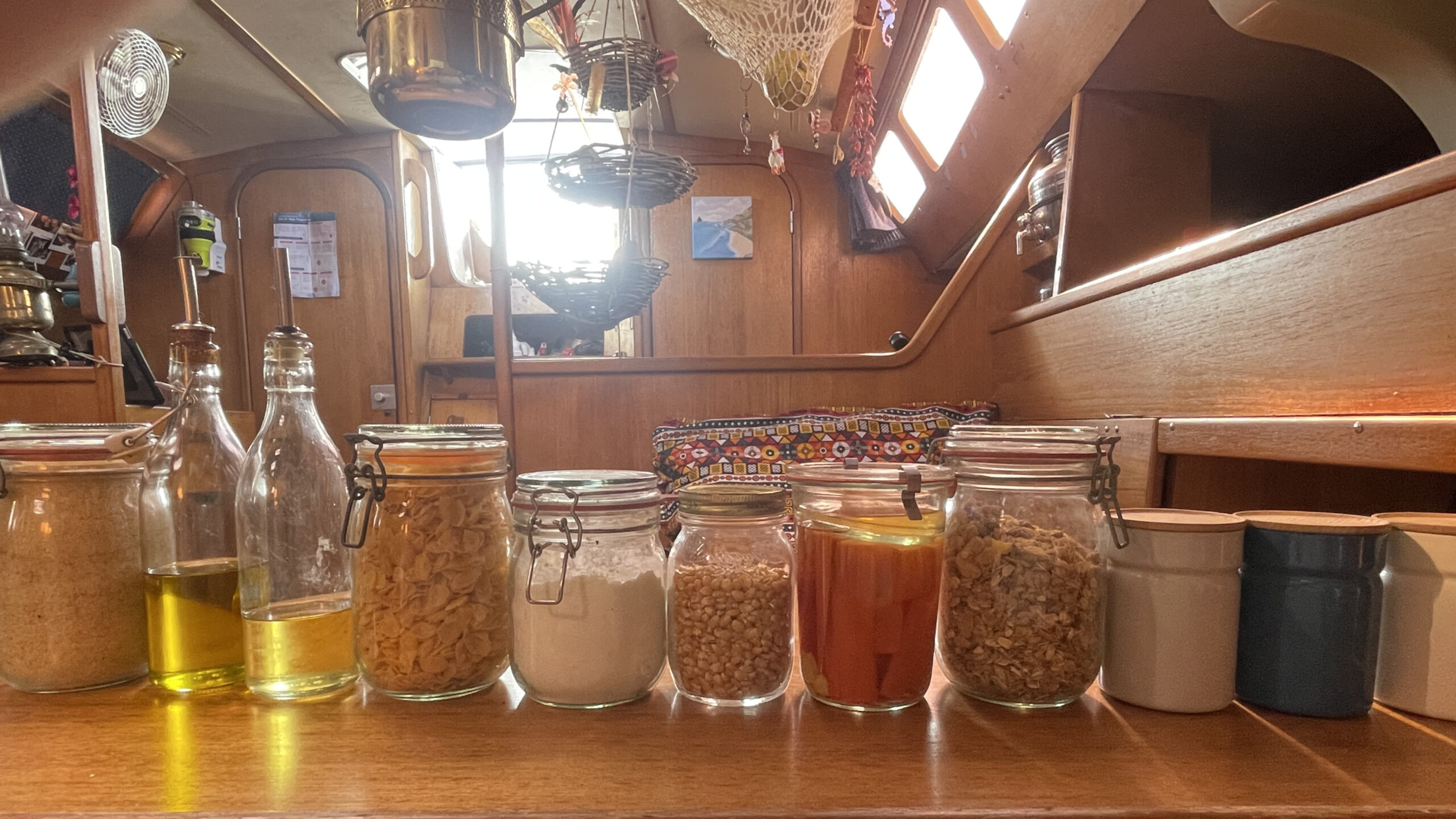
We don’t bring packaging to the boat — we bring our containers to the food.
We use:
- large food-grade containers for bulk storage
- glass jars for everyday use
- small jars for spices and snacks
Before shopping, we label our containers and fill them directly in the shop.
This means:
no repackaging, no waste coming on board, and less risk of pests.
Cleaning and hygiene products
This is where things get more complex.
Many conventional products contain microplastics or harmful chemicals — even when labels suggest otherwise.
Whenever possible, we refill products, use solid alternatives like shampoo bars, or make our own.
A simple homemade washing detergent can be made from soap flakes, soda, and baking soda — without plastic and without harmful residues entering the ocean.
When nothing is available
In places like Gambia, there are no zero-waste shops — and often no waste infrastructure at all.
But there are always markets.
We started bringing cloth bags and lightweight containers. At first, it felt a bit unusual — but more often than not, people were curious and happy to fill them.
For water, we had to adapt as well. In the river, our watermaker didn’t work. So we collected water from wells and boiled it on board. In other places, we relied on rainwater and solar energy.
These moments shift your perspective. You stop looking for the “perfect” solution — and start working with what’s there.
Small habits that make a big difference
One of the biggest advantages of life at sea is time.
If something isn’t available — we make it.
We started making oat milk instead of buying cartons.
We bake with our sourdough instead of using packaged yeast.
Every couple of weeks, we bake a big batch of cookies — so the tins are always full.
There’s almost always a jar of kimchi in our fridge. And somewhere on board, something is sprouting or growing.
These small routines don’t feel like effort anymore — they’ve become part of how we live.
Dealing with organic waste
We use a Bokashi bucket to ferment food scraps.
It reduces waste volume and produces liquid fertilizer for plants on board.
When full, we dispose of it responsibly — on land when possible, or at sea far offshore.
More than just waste reduction
What started as an effort to avoid plastic has become something much bigger.
It has led to conversations, connections, and shared experiences with people around the world.
Joining the In Mocean Recycling Fleet added another layer: not just avoiding waste — but actively working with it.
Today, we carry mobile recycling machines on board and run workshops with schools and communities to turn plastic waste into new products.
Our approach
We don’t aim for perfection.
Trying to be completely zero waste would quickly become stressful — and that’s not sustainable either.
Instead, we follow a simple principle:
Avoid what you can. Learn as you go. Adjust along the way.
And along the way, you might discover new perspectives, meaningful connections, and a different relationship with the resources you use.